
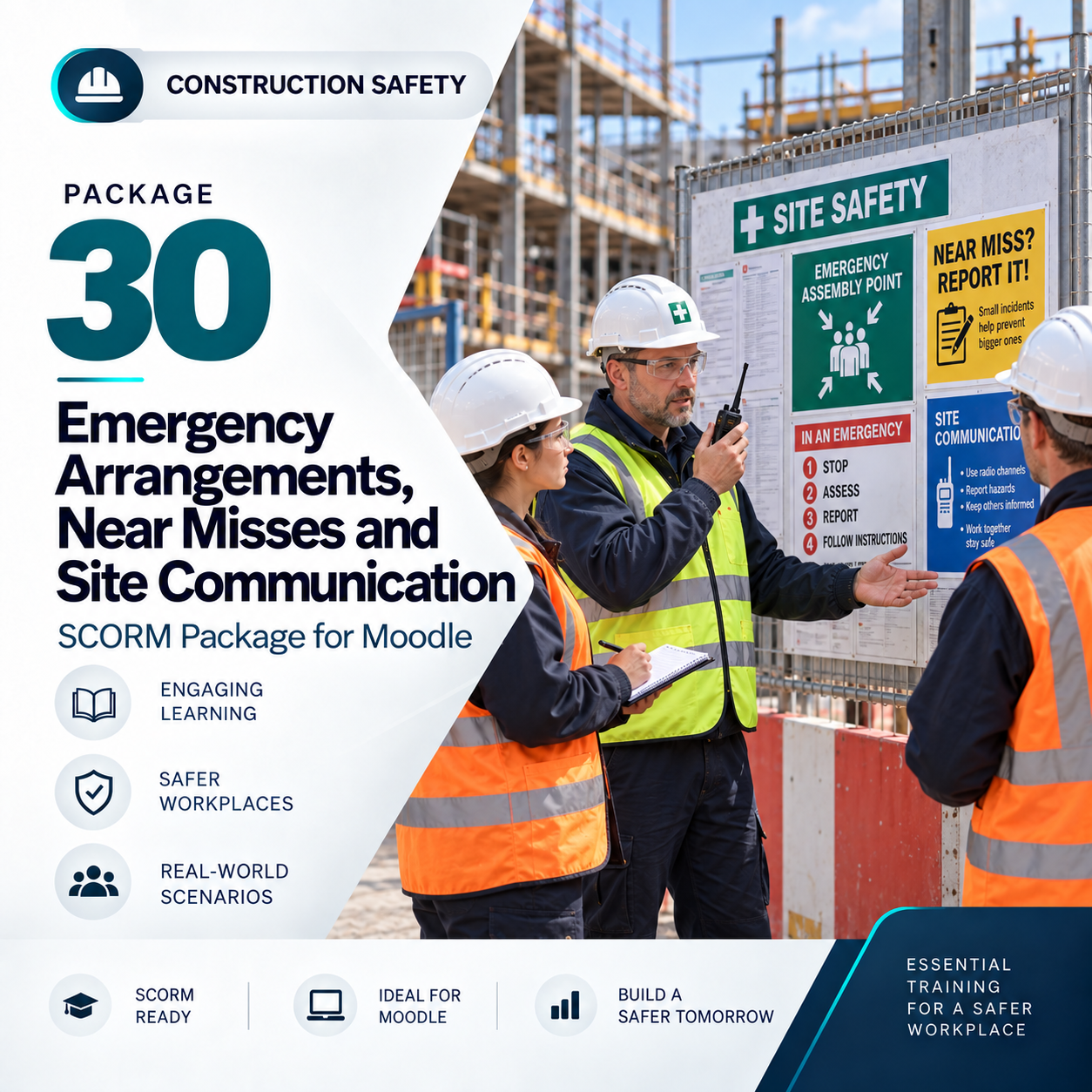
Emergency Arrangements, Near Misses and Site Communication
Follow an inducted records assistant during an evacuation at Site E30. Learners use current route information, report an unaccounted visitor accurately and interpret a limited escorted return without treating it as permission to resume all work. Separate cases reinforce near-miss reporting, understandable assistance arrangements and incoming cross-checks.
Value for your training programme
Provides a construction-awareness capstone that brings reporting and site communication together while respecting the real emergency plan and authorised response roles.
Suggested audience
Construction teams, contractors and supervisors coordinating site information.
Learning objectives
- Use the supplied emergency reporting arrangements promptly, without approaching danger or delaying for routine paperwork.
- Use the currently available designated escape route, report for accountability and respect planned assistance and role boundaries.
- Distinguish an event from a hazard, report near misses factually and support review of causes and effective corrective actions.
- Use understandable, two-way communication and cross-check current restrictions during briefings and handovers.
- Separate acknowledgement, alarm silence, route opening and task release, and retain restrictions that have not been lifted.
Seven-section learning path
- Know the emergency arrangements
- Inspect emergency and communication cases
- Use the current escape information
- Keep information and responsibilities clear
- An evacuation at Site E30
- Learn from near misses and follow up
- Check your learning
How learners work through the package
Learners read the supplied workplace conditions, examine six observation cases, answer practice questions and follow a branching scenario. They then complete an untimed ten-question assessment across five learning outcomes and review explanatory feedback. The package learning threshold is 80%; it is not a competence or legal-certification standard.
Learning controls and reporting
UK and US English browser narration, playback controls and transcripts accompany the written UK-English content. Text enlargement, high contrast, reduced motion, keyboard-operable controls and fullscreen support are included. Fullscreen and voice availability depend on the receiving environment.
Learners can review results, outcome scores, response explanations and optional reflection notes, with print, JSON and CSV outputs. Authorised facilitators use the receiving Moodle’s SCORM attempt, interaction and objective reports. A consolidated cross-course reporting dashboard is not included.
Delivery and requirements
A standalone SCORM 1.2 learning package intended for upload into your own Moodle site. A Moodle course, permission to add activities, appropriate settings and receiving-site testing are required. Hosting, enrolment administration, practical training, accreditation, update entitlement and support are not included unless the final product offer explicitly says otherwise. Confirm the product’s permitted use, licence and included files before purchase.
Important scope
This is awareness and decision practice, not a real emergency plan, incident investigation or permission to return to work. It does not qualify anyone to fight fires, perform rescue, give first aid, isolate equipment or direct an emergency. Follow the actual site plan, your training and the instructions of the responsible emergency personnel.


Reviews
There are no reviews yet.